Château Paradis Casseuil

The vintage
The 2023 vintage was characterised by an early growing season and contrasting weather conditions. Following a winter close to average, with sufficient rainfall and slightly cooler-than-average temperatures from mid-January to mid-March, budburst occurred in late March. The warm, wet spring favoured good flowering and fruit set, but also led to very high downy mildew pressure. Storms in late June exacerbated the damage in some plots that had already been affected. Veraison began in late July, followed by a ripening period marked by water stress and several spells of intense heat in August and early September. The Merlots were harvested from 8 September, followed by the Cabernets, with harvesting continuing until 21 September. A demanding vintage that once again demonstrates that quality does not necessarily go hand in hand with ease.
Location
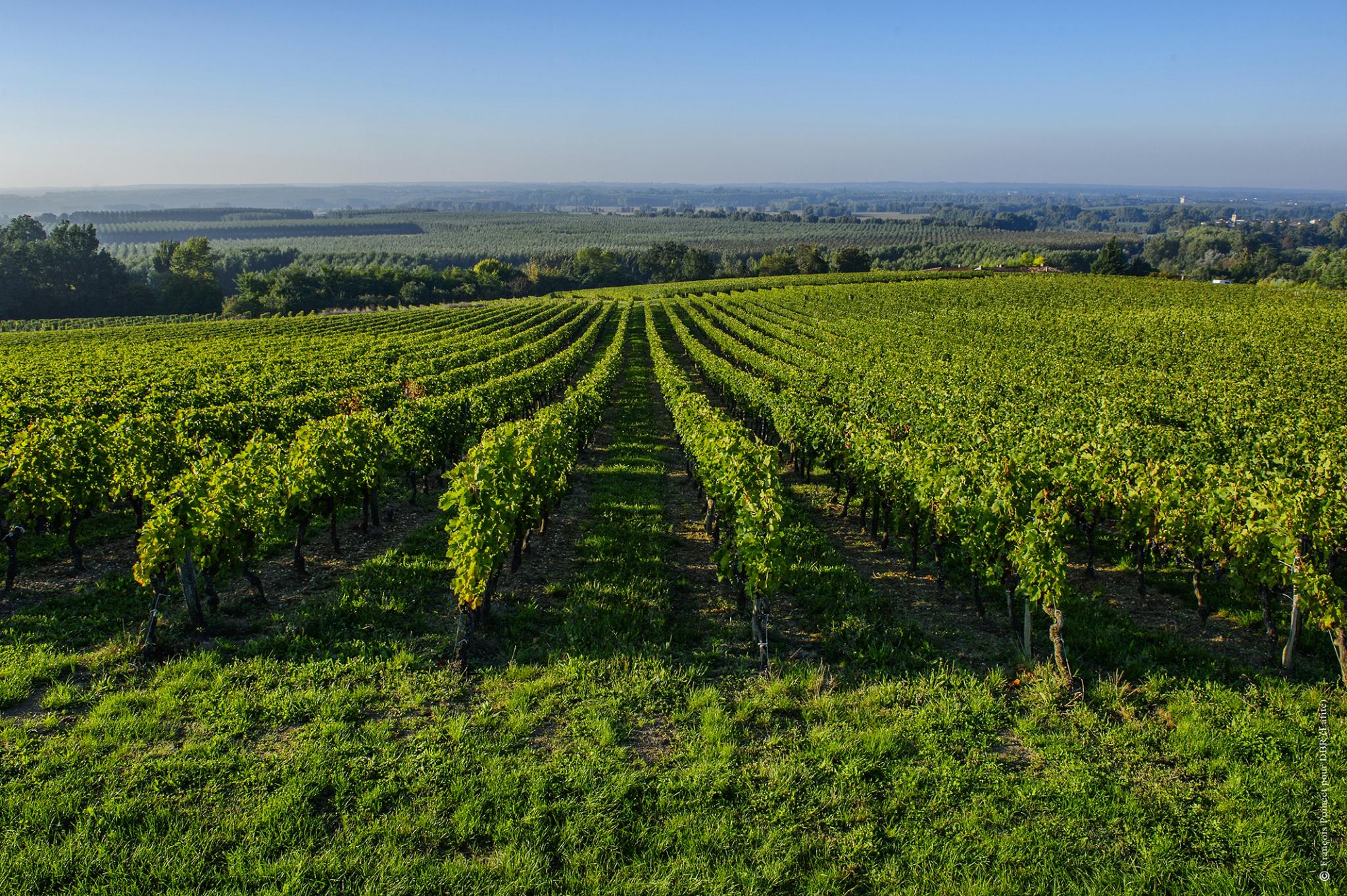
Paradis Casseuil covers some sixty hectares to the south-east of Bordeaux in the heart of the Entre-deux-Mers region. The vineyard is spread out over three communes, whose landscape of hills and slopes is reminiscent of Tuscany.
Terroir
The Paradis Casseuil terroir is mainly linked to the molasse of the Agenais, a typical geological formation of the Entre-Deux-Mers plateau, but also to the Asteria limestone, which appears at the place called "Le Paradis".
Over the course of the blocks, these two formations have a wide variety of sedimentary facies: sandstone limestone, marl, clay with calcareous nodules, variegated magnesian molasse, etc.
The soils that develop here are usually very clayey and rich in calcium. They thus benefit from excellent structural porosity, which is favourable to deep root development, but also from a certain coolness.
Winemaking
The water deficit significantly reduced the size of the berries, resulting in a substantial concentration of the tannins in the skins. Agility was required during the extractions, working with finesse and precision. Short macerations allowed to highlight the balance of this vintage, which combines richness with a fine tannic structure. The proportion of wine aged in oak was reduced compared to previous vintages to preserve the juicy character of the wine. A new milestone in the life of the estate.
Tasting
Deep, intense colour.
This wine reveals a remarkable balance of richness, fruit and freshness. The palate is structured, with pronounced tannins that lend definition and depth to the whole.
Downloads